smart intralogistics group
Applying lean thinking and automation to UK mid-tier logistics applications.
The Smart Intralogistics Group brings together specialist technologies and engineering expertise to help UK warehouse and manufacturing operations adopt automation in a practical, low-risk way.
saving time
Are you applying lean principles to workstation design, reducing reach distances, eliminating unnecessary process steps, improving ergonomics and visual management? This can deliver rapid return on investment, often well ahead of any technology deployment.
sharing data
Are you creating a practical framework ensuring that as a facility’s automation footprint grows, its data integrity and operational resilience grow with it? What about Cyber-secure architectures aligned with IEC 62443-4-2 standards?
automation?
Take the automation to where it's needed. The latest Mobile Cobots are rapidly changing the economics of robotics . By bringing portability they ensure they are fully utilised and not standing idle waiting for work.
Smart Growth
Be smart not clever. There's a lot to be said for keeping things simple. A modern smartphone is incredibly complex yet so easy to use. The same should apply to intralogistics solutions. Especially when there's a high staff turnover.
Forklifts and manual systems cost more than you think.
Forklift fleets are expensive, hazardous and space-consuming. Manual transport runs remove operators from value-added activity. And both create a ceiling on throughput that labour alone cannot overcome.
Labour Consumption
Manual transport, replenishment and material movement consumes operator time that could be used for packing, assembly or processing. In many operations, 60–80% of floor labour is associated with movement rather than adding value.
Floor Space
Forklifts require wide aisle clearances. Manual trolleys and cages consume circulation space. The result is that many mid-tier sites are using a third or more of their floor space to enable the movement process rather than the storage process.
Safety Risk
The interface between pedestrians and forklift traffic is one of the highest safety risks in warehouse operations. Automated internal transport removes this interface — improving safety alongside productivity.
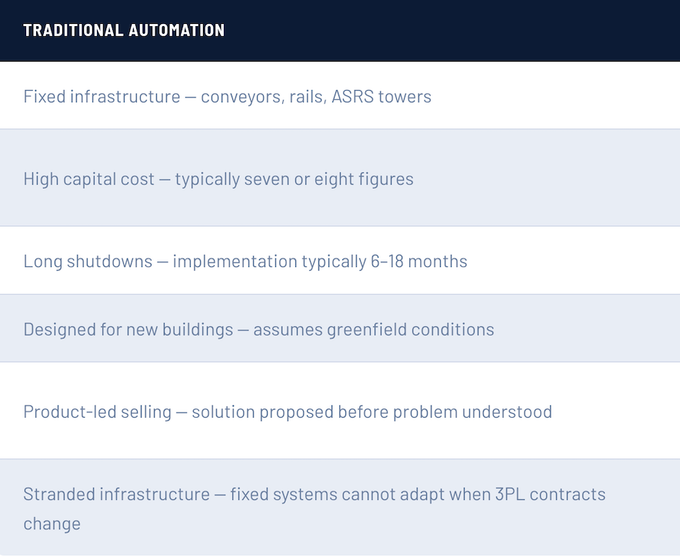
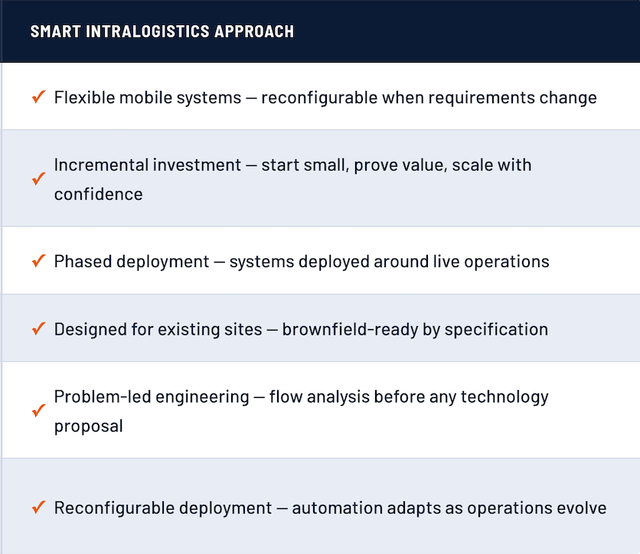
Traditional automation versus smart intralogistics.
The fundamental difference is not technology. It is philosophy.
The Automation Gap
Large automated distribution centres attract most of the attention and investment. The majority of UK logistics sites — mid-tier, brownfield, operationally complex — are largely ignored by traditional automation providers.
These sites are not small operations. Many employ hundreds of people, handle millions of orders per year, and manage supply chain complexity that rivals the operations of much larger distribution centres. What they lack is not the scale to justify automation — it is access to automation solutions designed for their constraints.
Traditional automation is engineered for large greenfield projects: fixed conveyors, ASRS towers, long implementation periods, and significant capital commitment. For mid-tier brownfield sites, this simply does not apply.
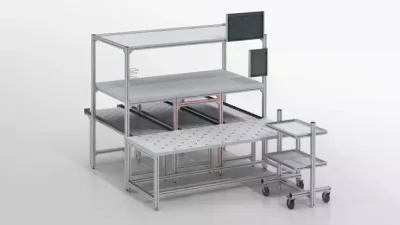
A good place to start is the manual workstation
Problem-first. Engineering-led. Incrementally deployable.
begin by asking where flow is being lost — and work systematically from there.
Understand the Flow
Map every material movement, operator journey and handling task. Most improvement opportunities become visible at this stage.
Identify Waste
Apply lean logistics principles to quantify movement cost, waiting time, handling frequency and process friction — in operational terms.
Improve the Workstation
Before automation, optimise workstation layouts to reduce reach, fatigue and interruptions. Often the highest-ROI step in the programme.
Automate the right movement
Deploy mobile cobots and AGVs to handle internal transport — freeing operators for value-adding work.
Create a secure system
Integrate AGVs, cobots, WMS and ERP using cyber-secure architecture designed to grow with your operation.
Scale Incrementally
Phased, brownfield-ready deployment without long shutdowns or fixed infrastructure — automation that adapts to your building.
Workstation Wisdom
Your packing bench may be costing you thousands of pounds every year — without anyone noticing.
Internal logistics efficiency is heavily influenced by workstation layout. Poor workstation design creates unnecessary movement, introduces delays, and generates operator fatigue that compounds over every shift.
One extra step. One awkward reach. One unnecessary twist. Repeated hundreds of times per shift, across every workstation, hidden inefficiencies quietly become major operational losses. At Smart Intralogistics Group, we see workstation design differently.
A packing bench is not furniture, it's a throughput machine. A well-engineered workstation reduces movement, improves ergonomics, increases consistency and recovers productivity that most operations never realise they're losing.
Cycle Time is the Dominant Cost Driver
Halve the cycle time → halve the cost. Poor bench design is not an ergonomics failure — it is a cost failure. Every second saved per pick at 500 orders/day is potentially worth around £3,100/year per operator.
Operators add value only during the act of packing. Reaching beyond 400 mm, searching for tools, rotating the torso — these destroy value. In poorly designed operations, 60–80% of pack time is non-value-added motion.

Cobots on the Move
Mobile cobots change the economics of warehouse automation by combining the flexibility of autonomous mobile platforms with the dexterity of collaborative robot arms — without fixed infrastructure.
The AGV problem was always the last metre.
Autonomous mobile robots can transport goods efficiently around a warehouse. But the final step — placing items at exactly the right position on a workbench, presenting them at the correct height and orientation, or removing completed packs — typically required a human.
The iCart MOCO platform addresses this directly: a Kassow 7-axis collaborative arm mounted on an autonomous mobile base. The result is a system that can navigate to a pick location, retrieve an item, transport it to a workstation, and present it precisely — without operator involvement in the transport cycle.
For warehouse operators, this means an operator at a packing bench can focus entirely on packing. Material arrives. Completed packs are removed. Replenishment is automatic. The bench becomes a continuous flow workstation rather than a stop-start interruption cycle.
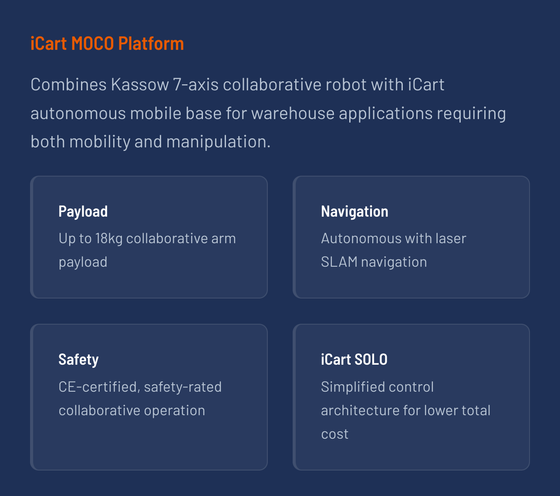
Kassow 7-Axis Collaborative Robots
The Kassow cobot arm provides exceptional reach and dexterity in a compact, lightweight design. The 7th axis enables natural motion paths that avoid collisions with racking and other infrastructure — critical for brownfield deployment.
Build the solution - step by step
Start small, apply in stages. Mobile Collaborative Robots like the iCart MOCO and i-Series can be implemented gradually sharing work with operators in a common workspace.
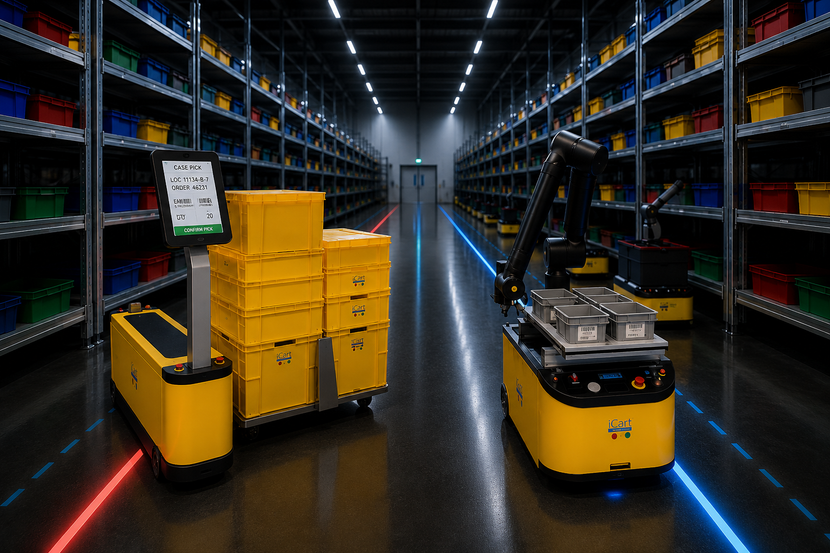
Mobile cobots are rapidly changing the economics of automation by bringing genuine flexibility to applications that were previously difficult, or prohibitively expensive, to automate.
The group demonstrates practical solutions using the iCart MOCO platform, combining autonomous mobile robotics using KASSOW cobots for applications such as pick-to-pack, pick-to-kit, and intelligent material delivery. iCart SOLO technology simplifies control architecture keeping costs to a minimum; ideal for tramming.
These systems are designed to adapt to the building, not the other way around. No fixed rails, no structural modifications, no extended downtime.
For a mid-tier site operating under a 3PL contract, this distinction matters enormously. When the contract changes, the automation can be reconfigured. That is a fundamentally different proposition from a fixed conveyor system that becomes stranded infrastructure the moment a client’s requirements shift.
Seeing practical automation changes the conversation.
Demonstration System
Most warehouse managers and operations directors who have not yet adopted automation have genuine, well-founded scepticism. They have seen vendor presentations. They have heard ambitious claims. And they have seen projects that did not deliver.
Our demonstration system is designed specifically for this audience. We show real equipment doing real tasks — the same tasks your team does every day. We explain what it costs, what it actually delivers, and what the deployment process looks like for a site like yours.
We also explain what automation cannot do, and where lean workstation design alone may be a more appropriate first step. Credibility requires honesty about constraints as well as capabilities.
iCart MOCO
See the iCart MOCO platform — a Kassow cobot arm on an autonomous mobile base — performing pick-to-pack, pick-to-kit and intelligent material delivery in a warehouse environment.
ctrlX Secure Automation Architecture
Cyber-secure automation platform with IEC 62443-4-2 alignment. Connect AGVs, cobots, WMS and ERP systems with confidence and governance-grade resilience.
Lean Workstation Design
Explore practical applications of lean workstation principles and how to identify and quantify movement waste in your own operation — with or without automation investment.
Real World Examples
Take a look at some existing applications of smart intralogistics
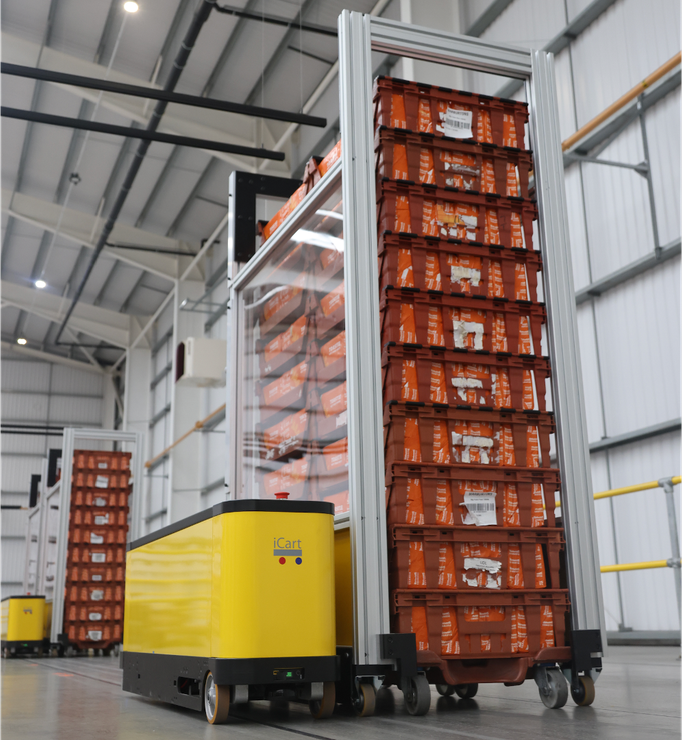
On the bread line?
Warburtons, a family business since 1876, employ around 5000 staff and are the largest UK bread supplier delivering over 4 million products daily. They use iCarts to move product through their distribution facilities.
The compact iCart iSeries transfers stacks of bread automatically around their distribution facilities without the need for major infrastructure changes. Fitted with a custom made carriage it integrates seamlessly with industry standard dollies
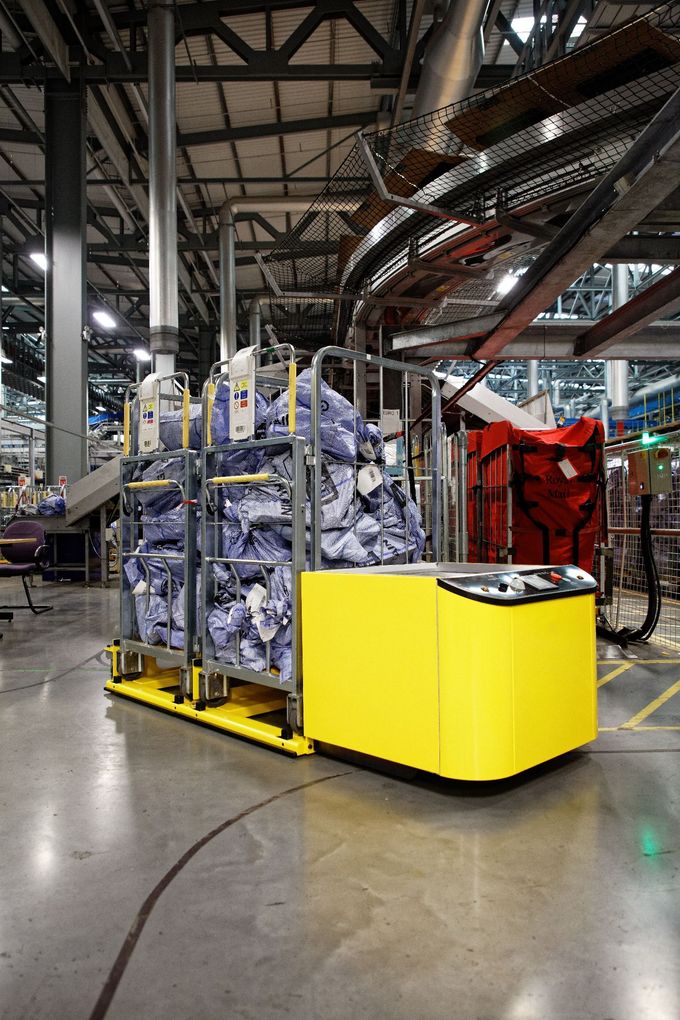
You have mail!
The internet brought about the demise of the letter but created a demand for efficient processing and delivery of small parcels on an unprecedented scale.
The combination of iCart AGV’s with iCart shuttle buffers was a “game changer” in mail transfer and buffering in mail centres. These “intelligent” robots work in swarms, co-operating with one another to minimise the need for intermediate manual handling operations during mail centre processing.
Around 200 iCarts operate on a single site bringing significant efficiency benefits.
our group

iCart-logistics
innovation in in-house logistics automation

Rexroth
your Factory - your way

ctrlX control solutions
automation without limits

Kassow Robots
powerful technology made simple
The smart intralogistics group brings together expertise from key areas of our partner companies. This skills partnership enables us to provide far reaching support across virtually all aspects of in-house logistics.
Efficiency savings are yours for the taking.
If you manage a mid-tier warehouse or manufacturing logistics site, the Smart Intralogistics Group exists precisely to support your operation. Make contact and start making progress.